
How AI Chatbots Reduce Shopify Cart Abandonment (With Data)
 Frederick Casey Housand - Mar 25, 2026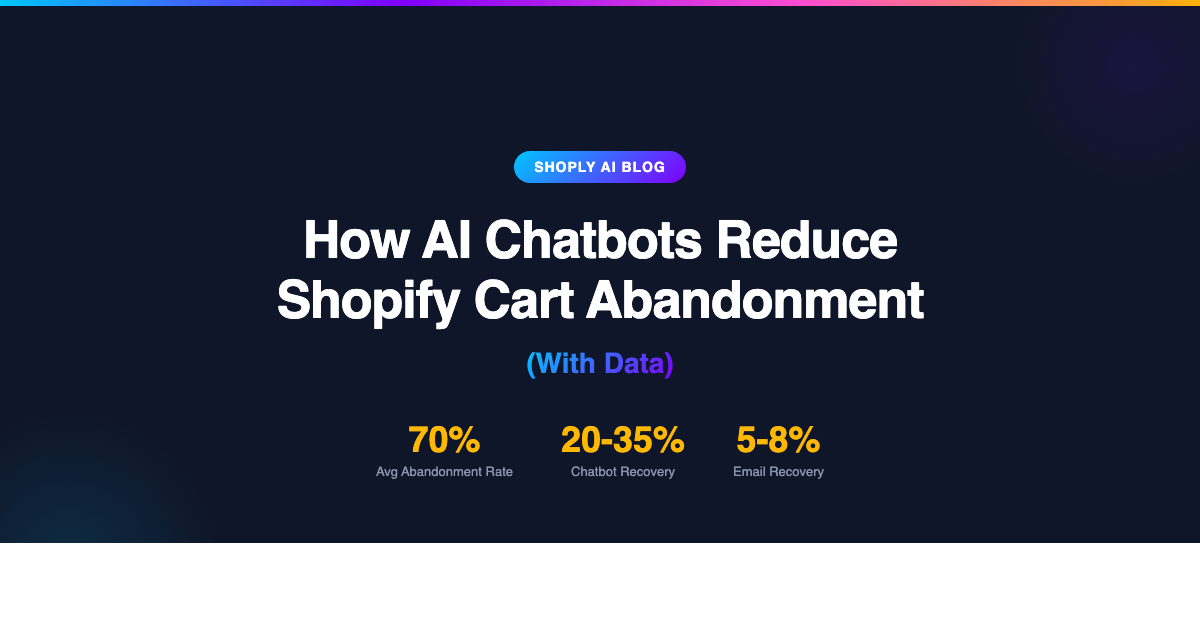
AI chatbots reduce Shopify cart abandonment by up to 20-35% by answering purchase-blocking questions in real time, before the shopper leaves the site. That number matters because the average Shopify store loses 70% of filled carts according to Baymard Institute research. The gap between a shopper adding a product to their cart and actually completing checkout is almost always an unanswered question: shipping cost, return policy, product compatibility, sizing. When that question goes unanswered for even a few minutes, the shopper is gone.
This article breaks down the mechanics of how AI chatbots intercept cart abandonment, how their recovery rates compare to email, and how to measure the impact on your store. For a broader look at AI chatbot options for Shopify, see our guide to the Best AI Chatbots for Shopify in 2026 .
Why Shopify Stores Lose 70% of Carts
The Baymard Institute’s aggregated research puts the average online cart abandonment rate at 70.19%. That means roughly 7 out of 10 shoppers who add items to their cart never complete the purchase. For a Shopify store generating 1,000 add-to-carts per month, that is 700 lost transactions. Even at a modest average order value of $60, that represents $42,000 in monthly revenue that made it to the cart but not through checkout.
Not all of that is recoverable. Some shoppers are comparison shopping or saving items for later. But a significant portion abandons for reasons a chatbot can address directly. Unexpected shipping costs account for 48% of abandonment according to Shopify’s own research. Forced account creation drives 26%. Complex or lengthy checkout processes account for 22%. These are friction points, not disinterest.
The third category of abandonable carts is the one most often overlooked: unanswered product questions. A shopper considering a security camera wants to know if it works with their existing NVR system. A customer looking at hiking boots needs to know if they run true to size. A parent buying a bike helmet wants to confirm it meets safety certification standards. These questions sit between the product page and the checkout button, and when the answer requires waiting for an email reply or searching through a static FAQ page, the shopper leaves instead.
Shoply AI addresses this directly through zero-setup autonomous learning. After installation, the chatbot reads your entire product catalog, store pages, and policy documents automatically. It starts answering product-specific questions from day one with no manual training, FAQ creation, or decision tree configuration required.
How AI Chatbots Intercept Cart Abandonment in Real Time
The distinction between chatbot intervention and traditional recovery methods is timing. Email campaigns, SMS reminders, and retargeting ads all operate after the shopper has already left. An AI chatbot operates while the shopper is still on the site, at the moment of highest purchase intent.
Real merchants see this difference clearly. IPcam-shop, a Netherlands-based security camera retailer using Shoply AI, reports that the chatbot’s “answers provided are 100% correct.” When a customer asks whether a specific camera model supports PoE or what resolution it records at, they get an accurate answer drawn from the product catalog in seconds. That accuracy keeps the customer on the product page and moving toward checkout rather than opening a new browser tab to research elsewhere.
Puffo Sport, an Italian sporting goods retailer, describes a similar dynamic: their customers frequently mistake the chatbot for a human agent. That level of conversational quality builds the purchase confidence that static FAQ pages cannot replicate. A shopper who trusts the answer is a shopper who completes the transaction.
The Shoply AI chatbot widget appears on every page of your store, ready to answer product questions the moment a shopper hesitates.
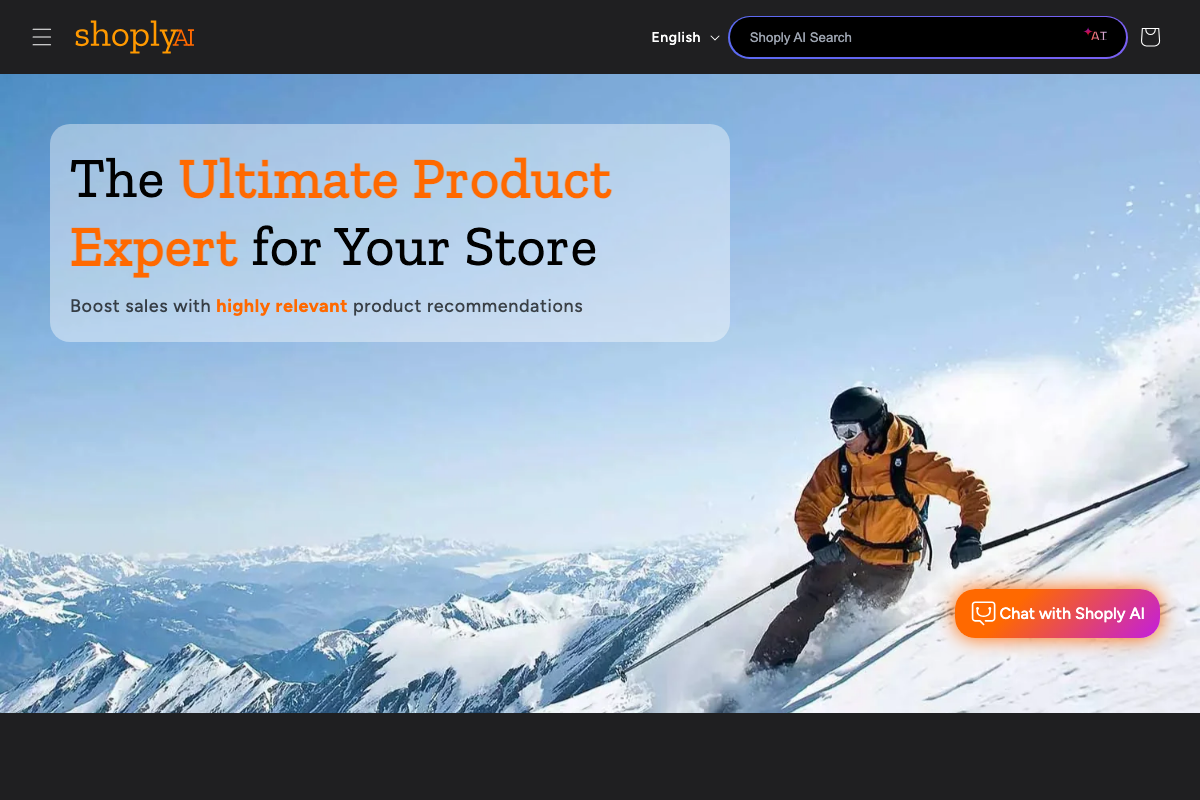
The upstream angle is equally important and one that no other solution on the market addresses the same way. Cart abandonment does not always start at the cart. It often starts with a failed product search. A shopper who cannot find the right product through your store’s search bar never adds anything to the cart in the first place. Shoply AI combines AI Search with Chatbot in a single product, so the entire path from product discovery to checkout is assisted. The search component helps shoppers find the right product; the chatbot answers their remaining questions before they leave. For a deeper look at how this combined approach works, see Chatbot or Search? Why Not Both?
Shoply AI supports 23+ languages with automatic detection, handles catalogs of over 1 million products, and carries the Built for Shopify badge. These are not incidental features. A store selling internationally needs the chatbot to answer a German customer’s sizing question in German, from the same English-language product data, without any additional configuration.
Chatbot vs. Email: Cart Recovery Rates Compared
The data on recovery methods tells a clear story about prevention versus recovery.
Email recovery campaigns typically recapture 5-8% of abandoned carts. These campaigns work by reminding shoppers that they left items behind, usually within 1-24 hours of abandonment. The problem is structural: by the time the email arrives, the purchase intent has faded. The shopper has either found the product elsewhere, reconsidered the purchase, or simply moved on. Email recovery is valuable, but it operates on the tail end of a problem that started on your site.
AI chatbots operate at the point of abandonment itself. When a shopper hesitates on a product page or lingers on the checkout page, the chatbot is available to answer the specific question causing that hesitation. Industry data from multiple vendor case studies shows chatbot intervention prevents 20-35% of cart abandonments. The difference is not incremental. It is a fundamentally different approach: prevention at the moment of intent rather than recovery after the fact.
The strongest results come from combining both methods. Use the chatbot to prevent abandonment in real time, and use email to follow up with the shoppers who leave despite having their questions answered. Combined approaches show 25-40% recovery rates in vendor-reported data. Shoply AI’s free plan lets you test the chatbot intervention at no cost, and paid plans start at $49.99 per month with a 7-day free trial.
How to Measure Chatbot Impact on Cart Abandonment
Measuring the chatbot’s effect on abandonment requires a baseline and a clear comparison period. Track four metrics before and after chatbot installation.
First, your cart abandonment rate from Shopify Analytics. This is the percentage of shoppers who add items to the cart but do not complete checkout. Record this weekly for 30 days before installation to establish your baseline. Second, your checkout completion rate, the inverse metric that confirms the trend. Third, chatbot engagement rate: what percentage of site visitors interact with the chatbot during their session. Fourth, conversion rate segmented by chatbot interaction: do shoppers who engage with the chatbot complete purchases at a higher rate than those who do not? Industry benchmarks show engaged shoppers convert at 12.3% versus 3.1% for non-engaged visitors, a 4x difference.
Run the comparison for 30 days post-installation with the same traffic conditions. Shoply AI’s built-in analytics track chat interactions, product recommendations served, and engagement patterns, so the data collection requires no separate tooling. The 7-day free trial on all paid plans means you can start measuring before committing to a subscription.
Frequently Asked Questions
How much can an AI chatbot reduce Shopify cart abandonment?
Industry data from vendor case studies shows AI chatbots reduce cart abandonment by up to 20-35%, compared to 5-8% for email-only recovery. Results vary by product complexity, traffic volume, and how well the chatbot is trained on your catalog. Shoply AI’s zero-setup learning means the chatbot starts answering accurately from day one.
Is a chatbot better than email for recovering abandoned carts?
They address different stages of the problem. Chatbots prevent abandonment by answering questions while the shopper is still on your site. Email attempts recovery after they have left. The most effective approach combines both: real-time chatbot prevention with email follow-up for shoppers who still leave.
How quickly will I see results after adding an AI chatbot?
Most stores see measurable changes within 2-4 weeks. Shoply AI requires no manual training and begins answering questions from your product catalog, policies, and store pages immediately after installation. The 30-day baseline comparison method described above gives you clear before-and-after data.
Try It on Your Store
See how Shoply AI handles product questions live on the demo store , or install it free from the Shopify App Store . All paid plans include a 7-day free trial with zero setup required. For a complete comparison of AI chatbot options, see our guide to the Best AI Chatbots for Shopify in 2026 .